
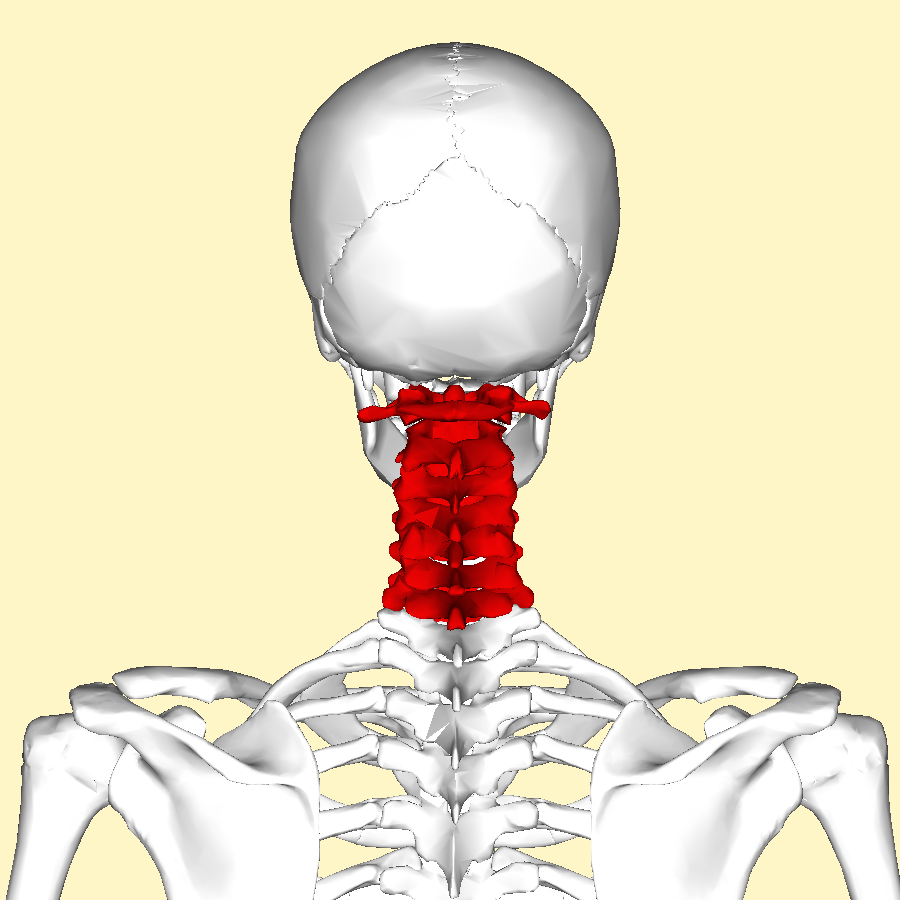
Photo · Anatomography · Wikimedia Commons
Journal
Cervical myelopathy: pressure on the spinal cord
Cervical myelopathy is compression of the spinal cord in the neck, often from disc and arthritic narrowing. The Alignment Clinic explains how it differs from a pinched nerve, and why the examination matters.

The Alignment Clinic and this problem
A pinched nerve in the neck usually sends pain or weakness into one arm. Myelopathy is different. The spinal cord itself is crowded, often by a disc, a bone spur, or a thickened ligament. People may notice clumsy hands, unsteady walking, or a heavy feeling in the legs. Neck pain can be mild or absent, which is why the problem is sometimes missed.
What the researchers studied
A 2015 review in Spine described the epidemiology and development of degenerative cervical myelopathy. A 2013 paper in Spine looked at how alignment of the neck is measured when the cord is compressed. A 2017 clinical practice guideline in Global Spine Journal brought together recommendations for people with this diagnosis.
What they found
The research treats myelopathy as a problem of cord function, not only of neck pain. Alignment of the cervical spine is part of the picture because the shape of the neck changes how the cord sits. The guideline discusses surgery for moderate and severe myelopathy, while milder cases are followed closely. The papers do not offer a single operation for every person.
How The Alignment Clinic approaches this
The examination looks for cord findings: balance, hand coordination, and reflexes. MRI shows where the cord is pinched. X-rays of alignment are often added before any talk of an operation from the front or the back of the neck. Some people are watched. Others are offered a decompression, with or without a fusion, when the cord findings and the images agree.
What a visit can clarify
A visit can tell a pinched nerve from cord compression, which are easy to mix up from a symptom list. It can also decide how closely the neck needs to be followed. This note is general information and is not a personal treatment plan.
Read next
The papers behind this note
- SSpine · 2015Degenerative Cervical Myelopathy: Epidemiology, Genetics, and Pathogenesis
- SSpine · 2013Cervical radiographical alignment: comprehensive assessment techniques and potential importance in cervical myelopathy
- GGlobal Spine J · 2017A Clinical Practice Guideline for the Management of Patients With Degenerative Cervical Myelopathy